Lubricant formulations are constantly being modified and improved. This means it’s not always possible to have experience with new formulations in order to compare them with your in-service lubricants.
While today’s formulations are designed to be superior to those developed 10 years ago, how can you confirm this? More importantly, what information is needed that will allow you to make comparisons between lubricants?
This article will describe industry-accepted tests for predicting lubricant life, including results from real commercial lubricants. Many of these tests are used by formulators when designing and evaluating new lubricants.
Comparing and analyzing these actual test results will reveal how to examine information from various resources and help you make better decisions about your lubricants.
The Lubricants
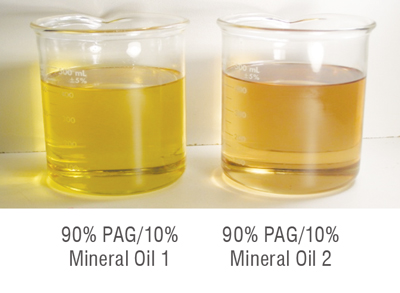
The lubricants in this study were turbine oils, which fall in the category of rust and oxidation (R&O) fluids. The samples tested included one polyalkylene glycol (PAG) oil and three different mineral oil formulations. The mineral oil formulations were chosen from a list of commercial products based on the American Petroleum Institute’s Group II and II-Plus base stocks.
They consisted of an older formulation, a new formulation and a new premium formulation. The PAG formulation was based on a Group V (synthetic) base stock. There are three types of synthetic PAG oils: water soluble, water insoluble and oil soluble. This study focused on water-insoluble PAG turbine oil. To complete the study, in-service lubricants were also obtained for these formulations if available.
The Tests
Since newer lubricant formulations may not have been in operation long enough for a comparable long-life measurement, bench aging tests are often used. The industry’s accepted aging tests include ASTM D2272, D2619 and D665(A). The lubricants in this study were aged by these standard test methods to assess their suitability for operation first as new lubricants.
After the aging tests were performed, the lubricants were measured to determine their condition. The second group of analytical tests included
For this, the lubricant was run to 75 percent to the end of a rotating pressure vessel oxidation test (RPVOT). This is based on ASTM D4378, which explains that a fluid is at its end of life when the RPVOT reaches 25 percent of the new fluid (75 percent to the end of the RPVOT). RPVOT adds excess water to the lubricant as part of the test, so water is already present to cause potential issues.
The rust test (ASTM D665A) for the new and oxidation-tested lubricants showed passing results. The rust inhibitor in all three fluids was found to be sufficient to protect equipment even at high water levels. However, the synthetic PAG lubricant indicated some discoloration that could be of concern, but it was not defined visually as rust, so the sample passed.
Leave a Reply